
Every time someone complains that 'I asked AI about my shop's return policy and got a generic answer', we always ask one question back: have you actually let AI read that document yet? In most cases, the answer is no, because general AI tools only know what they were trained on, not the policy file sitting on your computer. There's a technique called RAG that lets AI read your own documents before answering, like giving it its own filing cabinet. This article explains RAG as simply as possible, with a short exercise you can try yourself in a few minutes using a free tool.
When AI gives wrong answers because it doesn't know your internal documents
Ask ChatGPT, 'How many days does my shop allow returns?' and it gives a generic range, usually somewhere between 7 and 30 days depending on the store. Sounds familiar? That's because general AI tools only know what they were trained on: a huge pool of public information from the internet, not the return policy file sitting on your computer.
In other words, AI doesn't automatically 'see' your business documents unless you feed them in yourself. An employee might paste a few lines from a PDF into the chat, but the AI can still miss details in a long file, and it forgets everything once a new chat session starts, since each conversation begins with a blank memory.
This is the gap many shop owners and office staff run into when they start using AI: the tool sounds sharp on general knowledge but has no idea about your specific prices, policies, or internal process. To make AI answer like a staff member who has worked there for years, you need a way to feed your own documents in every time it answers. The next section explains exactly what that method is called.
What is RAG: like giving AI its own filing cabinet
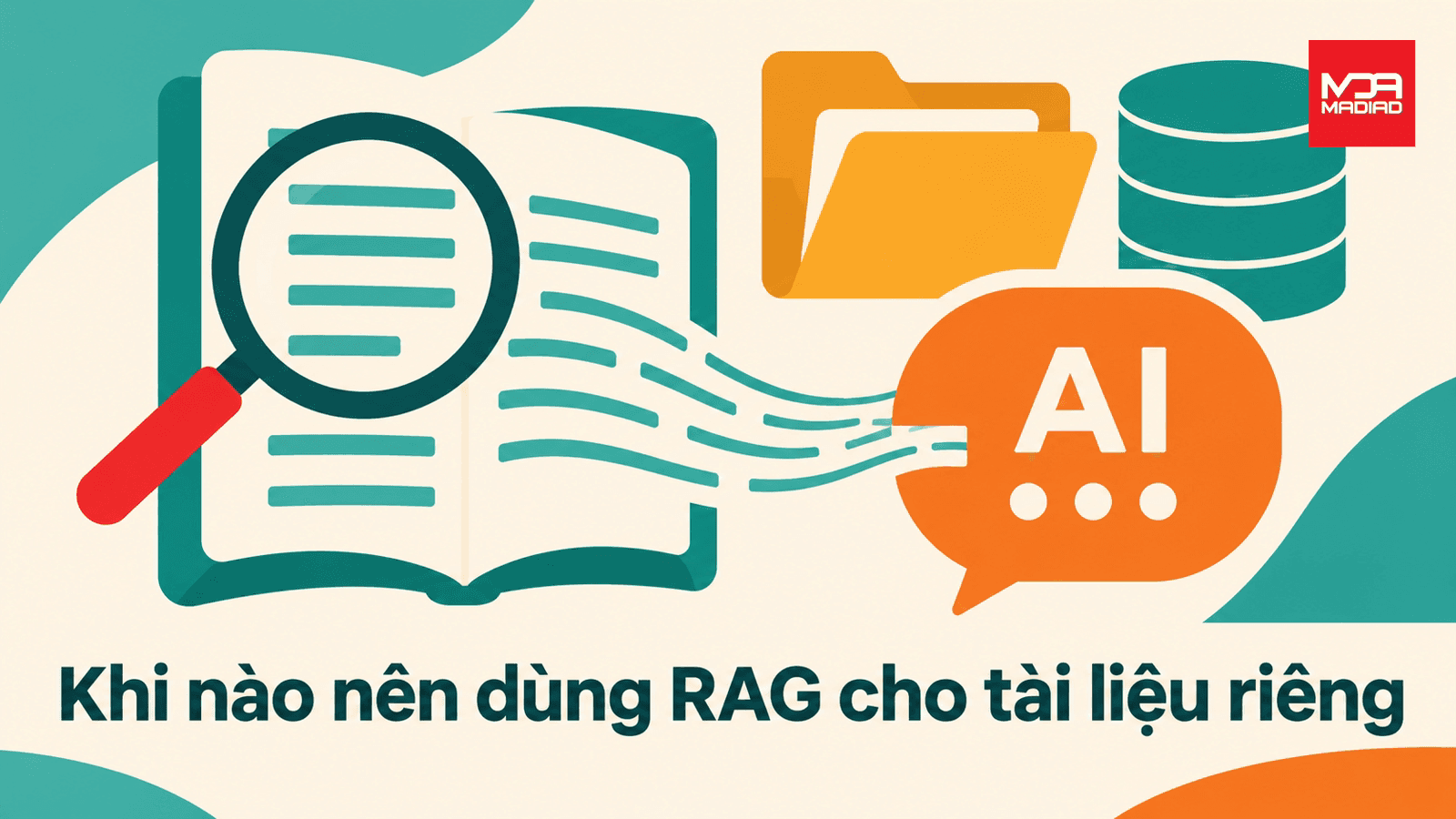
RAG stands for Retrieval Augmented Generation. That sounds technical, but think of it this way: RAG is like giving AI its own filing cabinet. Before answering, the AI opens that cabinet, pulls out the document that actually relates to your question, and only then writes a reply based on what it just read.
Two parts matter here. Retrieval is the step where AI searches your filing cabinet for the document that matches the question, similar to a staff member flipping through files to find the exact return-policy page. Generation is the step where AI writes the answer, but this time not from general knowledge: it writes based on the exact passage it just retrieved.
The difference is simple. Without RAG, AI answers from whatever it already memorized during training. With RAG, AI answers from your real documents, and you can update those documents anytime just by swapping the file in the cabinet. This technique also falls under the broader AI automation category that many businesses explore for real operations, for example letting a multi-channel chatbot (Chatbot đa kênh) answer according to each shop's own data. Next, you'll try a mini version of RAG yourself.
Try a mini RAG exercise yourself with a free tool in a few minutes
The fastest way to understand RAG is to try it once yourself, no coding needed. You need one short document, for example a price list or a return-policy file for your shop, saved as Word or PDF. The shorter it is, the easier it is to see the difference.
Next, open an AI tool that allows file uploads, for example the free version of ChatGPT or Google Gemini, both let you attach a file directly in the chat box. Before uploading anything, ask a question related to that document, for instance 'How many days does Shop X allow returns?' and note the answer down, it will likely be generic or the AI will simply say it doesn't know.
Then upload your document and ask the exact same question again. This time the AI has read the file you just gave it, and the answer will quote the actual number of days and conditions written in your document. Put the two answers side by side and the difference becomes obvious: one comes from general knowledge, the other from your real document. That is RAG running, just a tiny, manual version you can do in a few minutes.
Common misunderstandings about RAG, and when to hold off
The biggest misunderstanding: people think RAG makes AI 'smarter'. It doesn't. RAG does not upgrade the AI's brain, it just lets the AI read the right document before answering. The AI itself stays the same, it simply gets handed the correct reference at the right moment, similar to a capable employee who still needs to open the correct file to answer correctly, rather than suddenly becoming more skilled overnight.
Second misunderstanding: any internal document works fine once you plug it in. In reality, if your documents are messy, with policies scattered across different files and no clear headings, the AI will struggle to find the right passage, leading to wrong or incomplete answers. Documents need a reasonably clear structure before RAG can do its job well.
So when should a business hold off on building a full RAG system? When the data is still small, just a few pages, you can paste it directly into the chat each time instead of building a RAG system. When the data changes every day, setting up a complete RAG pipeline may not be worth it yet, because the effort of updating the filing cabinet could outweigh the benefit at this stage.
Continue the AI From Zero series by MADIAD
By now you have enough to tell the difference between an AI giving a generic answer and one actually using RAG, just from one small exercise with a free tool. You don't need to memorize every term, just remember the filing-cabinet image: AI opens the cabinet, pulls the document, then writes the answer.
RAG is just one concept among many that beginners run into when learning about AI. Each concept, explained the right way, can be understood in a few minutes without any technical background. That's the idea behind the 'AI From Zero' series: each article explains one concept, paired with an exercise you can do right away, with no paid tools required.
If you just finished the exercise above and are curious to understand other AI concepts the same easy way, keep following the next articles in the series. You don't have to read everything in one sitting either, saving this article to revisit later is also an effective way to learn, especially for terms like RAG that are easy to forget.
Conclusion
RAG sounds complicated at first, but at its core it just means letting AI read the right document before answering, nothing more mysterious than that. Quick self-check: (1) Where do your shop's internal documents currently live, scattered or organized? (2) If you asked AI about your own policy right now, would it answer correctly or generically? (3) Have you tried uploading a file to a free AI tool to compare the two answers? MADIAD keeps writing these plain-language AI explainers as part of the AI From Zero series. Continue to the next article in the series, or save this one to revisit when you need it.
Frequently asked questions
Is RAG worth it for a small shop with just a few pages of documents?+
Yes, it can still apply, but at a small scale you don't need a full RAG system right away. With just a few pages, the simplest approach is pasting the content directly into the chat each time you ask, similar to the exercise earlier in this article. RAG becomes more useful once the number of documents grows, for example a shop running several different policies across channels. A multi-channel chatbot (Chatbot đa kênh) serving many customers at once typically needs RAG to answer correctly for each policy type. You can keep reading other articles in the AI From Zero series to build up these concepts gradually.
How long does it take to set up real RAG for a business, and what does the process involve?+
It depends on how much documentation you have, but the process usually follows a few fixed steps. First, internal documents get collected and organized with clear headings. Next, those documents go into a storage system the AI can search, a step usually called indexing. Finally, that system gets connected to whatever AI tool is in use, for example a multi-channel chatbot (Chatbot đa kênh), so every question passes through a document-lookup step before getting answered. The exact timeline depends on how complex the data is; you can read more about how AI automation systems get built in other articles in this series.
What determines the cost of setting up real RAG for a business (beyond the free exercise)?+
The cost of building real RAG depends on a few factors, not a fixed number for every business. The first is the volume of documents to process, more files in more formats means more work to organize. The second is the number of channels to connect, for example just a website versus a full multi-channel chatbot (Chatbot đa kênh) running across several platforms. The third is how much customization is needed, whether documents update automatically or get refreshed manually over time. For a specific estimate for your case, MADIAD's pricing page (madiad.com/en/pricing) lays out these factors clearly.
Does RAG work with chat channels like Zalo, Messenger, or a website?+
Yes, RAG isn't tied to any single chat channel. At its core, RAG is just a document-lookup step before answering, so it sits behind whichever channel sends the question, a website, Zalo, or Messenger can all draw from the same document system. This is also why a multi-channel chatbot (Chatbot đa kênh) can answer consistently across all three channels: they all query the same RAG filing cabinet instead of three separate ones. If you want to go deeper into how chat channels get connected to one shared system, keep following the next articles in the AI From Zero series.
Once RAG is set up, what does a business need to maintain, and what runs on its own?+
The part that runs on its own is the lookup-and-read step every time a new question comes in, you don't need to do anything manually for that. The part a business needs to maintain is keeping documents current: when a return policy changes or a price list gets a new version, someone on the team needs to update the file in the system. If an old document stays in there without being removed, the AI might still answer based on outdated information. For a live multi-channel chatbot (Chatbot đa kênh), this is usually handled by whoever manages content on a regular basis. You can read more about this kind of operation in upcoming articles in the AI From Zero series.